Quick Answer
Vinyl printing uses printable self-adhesive films to produce graphics for surfaces such as glass, walls, panels and vehicles. The main practical choices are the film construction, adhesive, finish, printer/ink system, surface, expected service life and whether the graphic needs protection such as an overlaminate.
What Is Vinyl Printing?
Vinyl printing is the process of printing graphics onto a vinyl film, usually a flexible polymer film with an adhesive backing and release liner. The printed film can then be trimmed, cut and applied to a suitable surface.
Avery Dennison describes self-adhesive vinyl as a construction containing a face material, adhesive, release coating and backing or liner. The company also distinguishes sign-cut films from digital print films.
Major Types of Vinyl
| Type | Typical characteristics | Common applications |
|---|---|---|
| Monomeric calendered | Economical option for shorter-term, mainly flat applications. | Promotional graphics, temporary displays, basic signs. |
| Polymeric calendered | More dimensionally stable; suited to flat and slightly curved surfaces. | Walls, windows, retail graphics, fleets and signage. |
| Cast vinyl | Thin, conformable film designed for complex curves and recesses. | Vehicle wraps, curved surfaces and demanding graphics. |
| Perforated window film | Perforated construction allowing one-way visual applications when correctly specified. | Vehicle windows and building glazing. |
| Translucent vinyl | Allows controlled light transmission. | Illuminated signs and lightbox graphics. |
Film selection should follow the surface geometry, expected life, environment, adhesive requirements and printing system rather than choosing only by price. Avery Dennison notes that calendered films are generally suited to flat/simple curves while cast films provide greater conformability.
Cast vs Calendered Vinyl
| Factor | Calendered Vinyl | Cast Vinyl |
|---|---|---|
| Manufacturing | Film is formed by calendering. | Liquid coating process forms a thinner, more conformable film. |
| Surface suitability | Flat to slightly curved surfaces. | Complex curves, recesses and demanding contours. |
| Typical positioning | Promotional and general signage through higher-performance grades. | Premium vehicle graphics and long-term conformable applications. |
| Cost consideration | Often more economical. | Usually a premium material choice. |
These are general categories, not universal performance guarantees. Individual products differ in thickness, adhesive, durability and printer compatibility.
Printable Vinyl vs Cut Vinyl
Printable vinyl receives an inkjet image and is useful when the design contains photographs, gradients, multiple colours or detailed artwork.
Cut vinyl is supplied in coloured films and is cut into lettering, shapes or simple graphics, then weeded and transferred. It can be useful for solid-colour lettering and uncomplicated logos.
Some projects combine both approaches—for example, printed graphics with separate cut lettering or spot-colour elements.
Adhesive Options
Adhesive selection is important because removal, repositioning and long-term bonding depend on the product and surface. Common categories include permanent, removable and long-term removable systems. Some products also use air-egress channels or repositionable adhesive technology to make installation easier.
- Permanent: intended for long-term attachment.
- Removable: designed for planned removal within the manufacturer's stated conditions.
- Repositionable/easy-apply: designed to help with alignment and air management during installation.
- High-tack: useful where stronger initial adhesion is required, subject to surface compatibility.
Common Vinyl Printing Applications
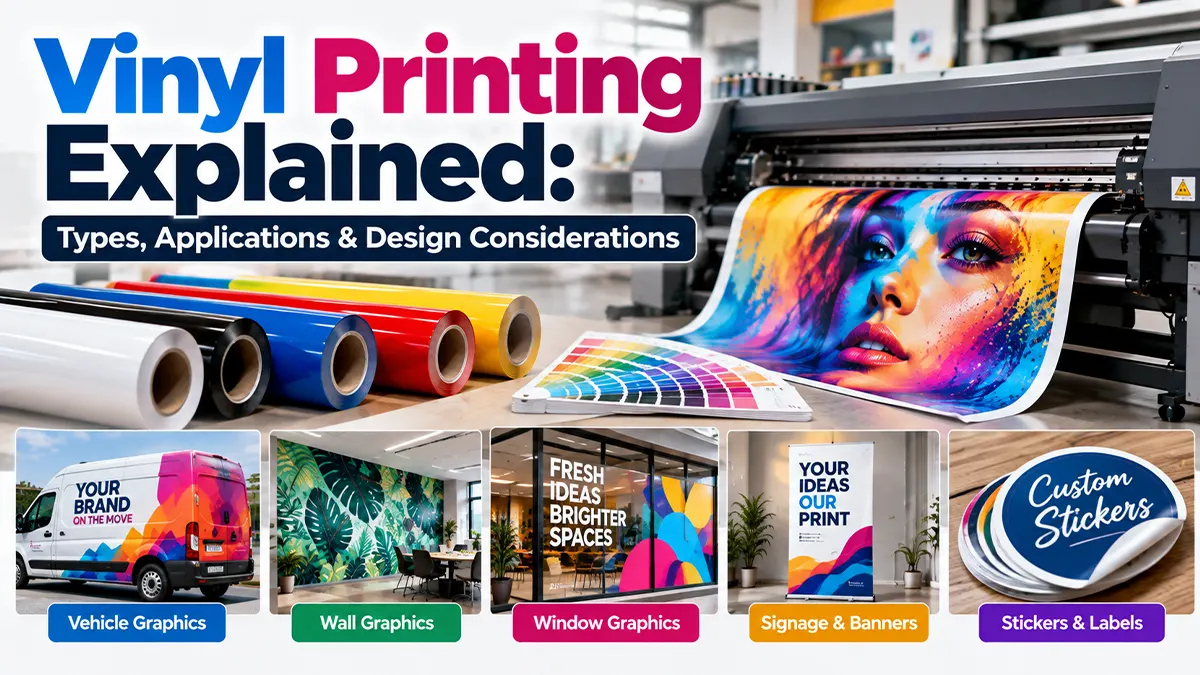
Vehicle Graphics
Fleet graphics and wraps often require conformable film, suitable adhesive and an appropriate protective laminate.
Wall Graphics
Interior walls can use removable or permanent films depending on paint, texture, duration and project requirements.
Window Graphics
Clear, translucent and perforated films can be selected for different visibility and light-transmission needs.
Retail & Promotional Graphics
Short-term promotional vinyl can be used for point-of-sale displays, exhibitions and temporary advertising.
Avery Dennison lists fleet, wall and window graphics among applications for its printable vinyl ranges and identifies short-term promotional films for POP, exhibitions and advertising.
Vinyl Design Considerations
- Know the viewing distance: use type and image detail appropriate to how close the audience will be.
- Check the final size: build artwork at the intended physical dimensions or at a documented production scale.
- Protect critical text: keep important information away from trim edges and complex contours.
- Choose colour carefully: check the intended print process, media profile and viewing conditions.
- Plan joins and seams: large graphics may require panels; place seams where they are least visually disruptive.
- Account for vehicle contours: important logos and text should not fall across deep recesses, handles or difficult transitions.
- Confirm adhesive and surface: painted walls, glass, metal and plastics can have different adhesion requirements.
When Should Vinyl Be Laminated?
An overlaminate can provide an additional protective layer and can change the final finish. The correct laminate depends on the printed film, ink technology, exposure, expected service life and application. Avery Dennison offers different overlaminate families for flat, simple-curve and specialised applications.
Lamination should not be treated as an automatic requirement for every vinyl project. Follow the film and ink manufacturer's compatible-system recommendations.
Surface Preparation Matters
Even a high-quality vinyl can fail when applied to an unsuitable or poorly prepared surface. The substrate should be clean, dry, stable and compatible with the selected adhesive. Painted surfaces should be sufficiently cured, and textured surfaces may require a film specifically designed for that texture.
For wall graphics, Avery Dennison recommends selecting the film according to the wall condition and strongly recommends test application to the intended surface to verify adhesion.
Vinyl Printing Workflow
- Define the application, surface and expected duration.
- Select the film construction and adhesive.
- Prepare artwork and confirm production dimensions.
- Check printer, ink and media compatibility.
- Print and allow the manufacturer's recommended processing/curing time.
- Apply laminate when the specified system requires it.
- Trim, weed or contour-cut as required.
- Prepare and clean the installation surface.
- Apply the graphic using the recommended installation method.
- Inspect edges, seams, adhesion and final appearance.
Common Vinyl Printing Mistakes
- Choosing a low-cost film for a demanding curved or outdoor application.
- Ignoring adhesive compatibility with the substrate.
- Using the wrong laminate or mixing incompatible products.
- Stretching a film beyond its intended conformability.
- Printing without checking the correct media profile and printer settings.
- Applying graphics to dirty, damp, uncured or unsuitable surfaces.
- Placing important text across deep recesses, seams or trim areas.
- Assuming every vinyl product has the same outdoor life.
Print-Ready Vinyl Checklist
| Artwork | Correct dimensions, bleed/trim plan and readable typography. |
|---|---|
| Images | Sufficient effective resolution for the final viewing distance. |
| Colour | Correct print workflow, profiles and proofing where required. |
| Media | Film selected for surface, duration, environment and printer. |
| Protection | Compatible overlaminate specified where required. |
| Installation | Surface preparation, temperature and application method confirmed. |
How to Choose the Right Vinyl
Start with the application rather than the printer. Ask: Is the surface flat or curved? Is the graphic indoors or outdoors? How long should it last? Is removal important? Does the surface have texture, rivets or recesses? Does it need to be laminated? What printing technology will be used?
For flat promotional work, a suitable calendered film may be practical. For demanding contours such as vehicle wraps, a conformable cast film may be more appropriate. Product-specific technical data should always take precedence over generic categories.
Final Takeaway
Vinyl printing is not one single material or process. Performance depends on the film construction, adhesive, ink and printer, laminate, surface and installation conditions. Matching those variables to the actual application is the key to achieving predictable print quality and service life.
Frequently Asked Questions
Disclaimer
Vinyl performance varies by product, printing system, surface, environment and installation. This article provides general informational guidance and does not replace the technical data sheet or application instructions for a specific vinyl product. Confirm compatibility and durability with the film, ink and laminate manufacturers before production.
Planning a Vinyl Printing Project?
Share your application, surface, dimensions and expected usage to discuss suitable vinyl printing options.
Get a Consultation